
82: What Happens When Google Releases an AI App and Forgets to Tell Anyone?
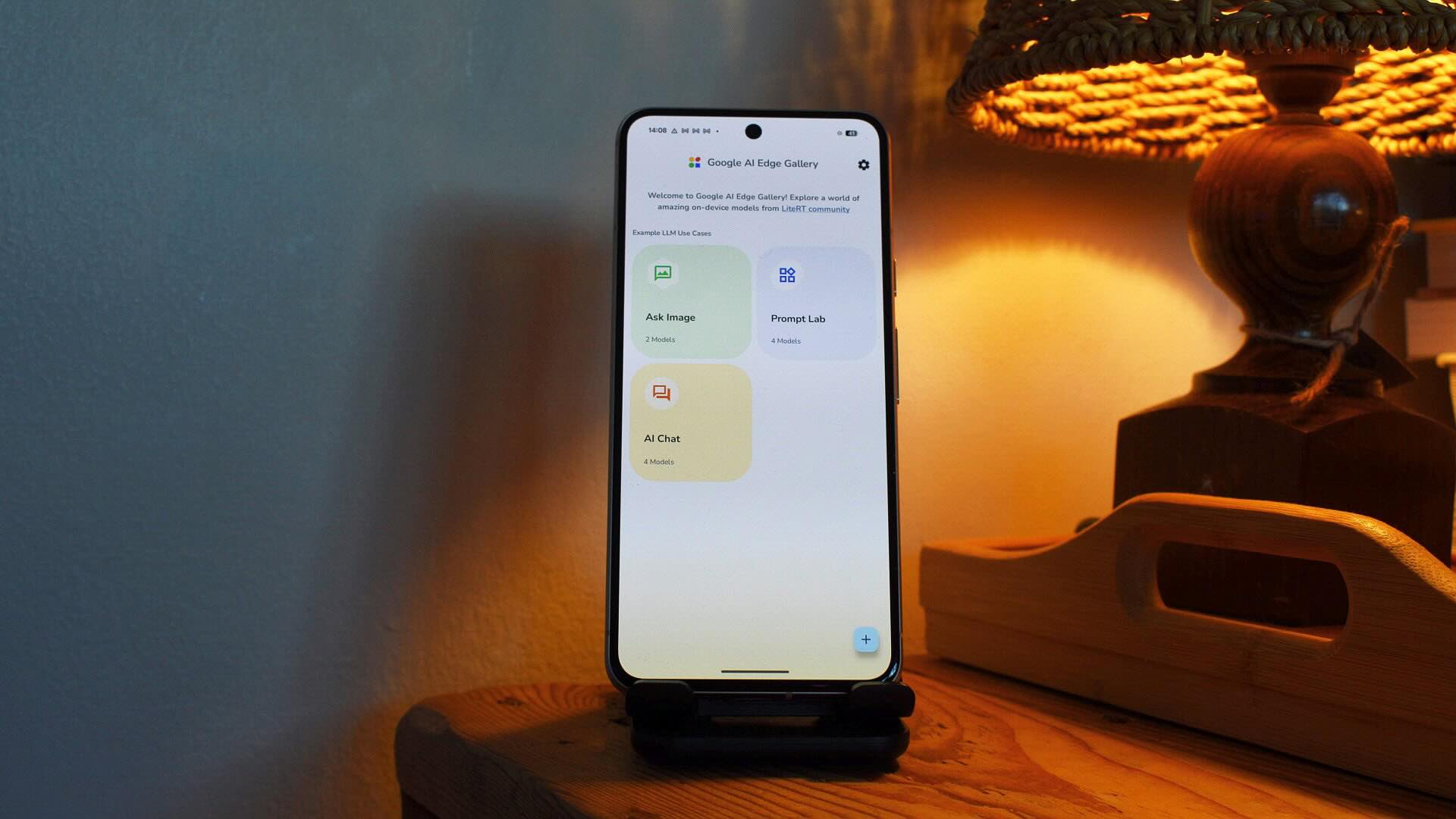
Google AI Edge Gallery
Get it on Playstore Get it on the App Store
This app is an open-source, experimental playground app designed to demonstrate on-device generative AI capabilities using Google's Gemma model family. Initially distributed via GitHub, the app graduated to the Google Play Store in open beta in late 2025, reflecting strong community interest, it reached 500,000 APK downloads in just two months during its GitHub-only phase . The app serves as both a consumer-facing demo and a developer reference implementation for Google's edge AI stack (LiteRT/MediaPipe).
Core Capabilities
The app is organized around distinct task modes that showcase different on-device AI capabilities :
What It Does Well
1. Genuine Offline Privacy
The app's primary value proposition is uncompromising local processing. Once models are downloaded (1–4 GB depending on variant), all inference occurs on-device. There is no account creation, no telemetry by default, and no data transmission; a meaningful differentiation from cloud-dependent assistants . For sensitive use cases (medical questions, confidential documents, personal brainstorming), this architecture eliminates third-party exposure risks entirely .
2. Accessibility vs. Technical Depth
Unlike earlier local LLM solutions (Ollama, LM Studio) that require command-line proficiency or desktop hardware, AI Edge Gallery offers a polished mobile-native UI with straightforward model installation . The Play Store distribution removes the friction of GitHub sideloading, though the app retains its open-source codebase for developer inspection .
3. Multimodal On-Device Execution
Gemma 3n's ability to process text, image, and audio inputs locally on a smartphone is technically impressive. The model handles object identification, text extraction from images, and spoken language translation without connectivity — capabilities that were server-dependent just months ago .
4. Transparency & Developer Utility
Real-time token-per-second metrics and exposed inference parameters make this a practical benchmarking and prototyping tool for mobile AI developers, not merely a consumer demo .
Limitations & Trade-offs
1. Performance Constraints
On-device inference is hardware-bound. On a Pixel 8, complex prompts can take minutes to process, and the device runs noticeably warm during sustained use . Response quality, while solid for factual Q&A and summarization, falls short of cloud frontier models (GPT-4, Gemini 1.5 Pro) on nuanced reasoning, creative writing, and multi-step planning .
2. Context Window & Memory
The Gemma 4 E2B model supports up to 32K context substantial for on-device, but a fraction of cloud offerings (Claude's 1M tokens). More critically, conversation history lacks persistence; closing a thread effectively resets context, unlike ChatGPT or Gemini which maintain long-term conversational memory .
3. Storage Requirements
Models consume 1–4 GB each. Users with limited device storage must carefully manage downloads, and running multiple models simultaneously is impractical on mid-tier hardware .
4. Feature Asymmetry & Stability
Audio capabilities arrived on Android before iOS, and some experimental features (like Mobile Actions) remain unevenly implemented. Backgrounding the app can trigger non-responding UI states or crashes when returning to focus . Swipe gestures accidentally clearing prompts represent a notable UX friction point.
5. No System Integration
Unlike Gemini or Google Assistant, AI Edge Gallery cannot control device functions (flashlight, Spotify, navigation) or access real-time web data. It is a self-contained text/image/audio processor, not a virtual assistant replacement .
Target Audience
Privacy-conscious users seeking AI assistance for sensitive queries without cloud exposure
Developers and researchers prototyping on-device AI applications using Google's edge stack
Travelers and field workers requiring AI capabilities in connectivity-dead zones
AI enthusiasts wanting to benchmark local model performance on their specific hardware
It is not recommended as a primary replacement for ChatGPT, Claude, or Gemini for users requiring complex reasoning, long-document analysis, or seamless multi-session memory.
Verdict
Google AI Edge Gallery is a technically accomplished proof-of-concept that successfully demonstrates the viability of useful on-device generative AI on consumer smartphones. It trades the raw capability of cloud models for uncompromising privacy and offline resilience; a legitimate and increasingly important value proposition.
However, the "experimental" label is warranted. The app is more research showcase than polished consumer product: performance varies significantly by hardware, context persistence is limited, and the feature set is deliberately narrow. For its stated purpose — inspiring developers and enabling private, offline AI experimentation — it succeeds admirably. As a daily driver AI assistant, it remains a complement to, rather than replacement for, cloud-based services.
Rating: 7/10 — Impressive technical achievement with clear use-case boundaries. Worth installing for privacy-critical scenarios and developer exploration; manage expectations for general productivity replacement.